
Author: Terry Pittman

The Law of Self Defense: Element 5 – Reasonableness
In my previous article titled “Avoidance in Self-Defense Law Explained” I discussed Stand Your Ground, Duty to Retreat, and the Castle Doctrine. I reviewed each of these areas individually and outlined how each area relates to your use of force and the requirements for a lawful self-defense claim.
In this article, I would like to discuss the fifth and final element of “The Law of Self-Defense”: Reasonableness
REASONABLENESS– WHAT IS IT?
The element of Reasonableness serves as an umbrella that covers the other four remaining elements – Innocence, Imminence, Proportionality, and Avoidance.
When acting in self-defense everything you do – your perceptions, your decisions, and your actions must be considered as reasonable.
- Innocence: Did you possess a reasonable belief that you were not the initial aggressor if defending yourself or if defending a third party who was not the initial aggressor?
- Imminence: Did you possess a reasonable belief that you were facing an imminent threat (one that was already in progress or immediately about to happen)?
- Proportionality: Did you possess a reasonable belief that the amount of force you were defending against was proportional? The amount of force used was not greater than the amount of force you were defending against.
- Avoidance: Did you possess a reasonable belief that there was no way to safely retreat? Remember, the best fight is the one that you are never in. Even if you are not legally required to retreat (ie: Stand Your Ground) if you can do so safely and without increasing your jeopardy this is always a good option. Even in the majority of Stand Your Ground states where you do not have a generalized duty to retreat, a prosecutor can attack the element of Avoidance through the element of Reasonableness. A prosecutor could claim that you could have reasonably retreated without using force. If the jury agrees your self-defense claim collapses in its entirety.
If you answer “No” to any of the above questions, then your actions would be considered as unreasonable and not lawfully permitted.
When you are compelled to use force in self-defense, your actions will be evaluated by others. This includes police who will conduct an investigation, a prosecutor who will review the police investigation and evidence, and if criminally charged a jury will hear the case and ultimately decide your fate.
Our criminal justice system applies a two-part test to determine if a defendant acted reasonably:
- Cautious
- Does not take unnecessary risks
- Adherence to safety guidelines
- Obeys traffic laws
- Knows that fire is hot
- Knows that firearms are dangerous
- Sober
- Responsible
- Slow to anger
- Common knowledge
Reasonable Ralph serves as a “template” beginning as a reasonable and prudent person. He needs to be customized to be more like you as the defendant. Reasonable Ralph needs to be given some of your mental and physical attributes to be more like you and understand the situation you faced when acting in self-defense.
- Are you young and physically fit?
- Are you elderly or suffer from some type of handicap or disability?
- Do you have any specialized training such as martial arts?
Reasonable Ralph takes on the physical characteristics you had at the time of the attack.
Reasonable Ralph has basic common knowledge. As a defendant, do you have any specialized knowledge that you possessed at the time of the attack that impacted or influenced your decision making in the moment?
If I were involved in a use of force incident, for example, I do have specialized knowledge that would influence my decision making when acting in self-defense:
- Former law enforcement experience
- Concealed Carry Firearm Permit and Training
- My personal Facebook page which is dedicated to lawful self-defense and related topics. This is documented social media content that shows I possessed specialized knowledge on many topics. This would be relevant to show that I possessed such knowledge before a use of force event. Such knowledge can be used to customize Reasonable Ralph.
If you are criminally charged and your case goes to trial, a jury will ultimately be the “finder of fact.” They will evaluate all the evidence and testimony of the case. Each juror will “stand in your shoes” and decide if your perceptions, your decisions, and your decisions were objectively reasonable.
SUBJECTIVE REASONABLENESS
Not only must your perceptions, your decisions, and your actions be objectively reasonable, but they MUST also be subjectively reasonable. Subjective reasonableness means that you had a genuine, good faith belief that you acted reasonably under the circumstances in self-defense.
While no one can get inside your head and know with absolute certainty what you were thinking when acting in self-defense, your words and conduct can leave a reasonable inference to others. For example, if you state you used force because you were afraid and later make a statement that you were not but just wanted to teach your attacker a lesson, a prosecutor could argue your use of force was not subjectively reasonable. You really did not have a genuine, good faith belief.
CONSCIOUSNESS OF GUILT
Where a self-defense claim oftentimes will fail, however, is through the defendant’s conduct. Consciousness of Guilt behaviors can undermine subjective reasonableness.
Consciousness of Guilt refers to a powerful and highly incriminating inference that a judge or jury may draw from the statements or conduct of a defendant after a crime has been committed suggesting that the defendant knows he or she is guilty of the charged crime.
In other words, the defendant’s conduct after the crime is circumstantial (indirect) evidence that the defendant intended to commit the crime, or in fact, committed the crime.
Common examples of consciousness of guilt include:
- Fleeing from the crime scene or jurisdiction
- Fleeing from police
- False statements and lies
- False alibi
- Changing name or personal appearance
- Concealing or destroying evidence (including a body or weapon) also known as “tampering with evidence”
Although a defendant is presumed innocent by law until proven guilty in court, an aggressive prosecutor can ask a judge to provide a jury instruction for Consciousness of Guilt. The jury may then consider the instruction in their deliberations. Not only does the prosecutor think you are guilty but it also suggests that your own conduct leads others to think that you are guilty also. This type of instruction can seriously damage a defendant’s self-defense claim.
Even if you do not engage in any behavior that suggests guilt or that you did anything wrong, you can still undermine subjective reasonableness, For example, if you are in an argument with someone who is threatening you and you continue to follow them while they backing away, a prosecutor could argue that you did not have a genuine, good faith subjective belief that you were in fear of them. To put it quite simply, you don’t go to the fight. Going to the fight does not look like self-defense. You should always let the fight come to you. A reasonable person does not pursue pain and would seek to de-escalate the situation if able to do so without increasing their jeopardy.
WHAT ABOUT REASONABLE MISTAKES?
You are not required to make perfect decisions when acting in self-defense. You are allowed to make mistakes in self-defense as long as they are reasonable mistakes.
If someone points a “toy” or fake gun at you, for example, and you perceived it was a real one by shooting your attacker with a real gun, you could argue that you responded reasonably under the circumstances. It looked real and was indistinguishable from a real gun.
In self-defense you are allowed to make mistakes of fact. The fact that your attacker’s gun was not real is immaterial. You are not allowed, however, to make mistakes of law such as a misunderstanding of the law (what you thought the law was versus what it actually is).
IMPERFECT SELF DEFENSE
Imperfect self-defense applies when a defendant acts with an honest, genuine belief that they are in imminent danger of death or great bodily injury, but that belief—or the amount of force used—is judged to be objectively unreasonable by a reasonable person(s) such as a judge in a bench trial or jury in a jury trial. Although you believed your perceptions, your decisions, and your actions were subjectively reasonable, a judge or jury did not share that same subjective reasonable belief.
An example of imperfect self-defense is when a person genuinely (subjectively) believes they are in immediate danger of death or great bodily harm and uses lethal force, but an objective reasonable person would not have perceived that level of threat. A judge or jury believed that you acted objectively unreasonable.
Key Elements of Imperfect Self-Defense:
- Honest (Subjective) Belief: The defendant truly, in their own mind, believed lethal force was necessary.
- Unreasonable (Objective) Standard: A neutral jury or judge decides that a reasonable person in the same situation would not have used lethal force (meaning the threat wasn't legally proportionate or real).
- Partial Defense: Unlike "perfect" self-defense—which results in a full acquittal (not guilty)—imperfect self-defense does not completely excuse the crime; it only lowers the severity of the conviction and prison sentence
Subjective vs. Objective Standard:
- Perfect self-defense requires both a subjective (the defendant actually believed it) and an objective (a reasonable person in the same situation would have believed it) standard.
- Imperfect self-defense only requires the subjective standard – the defendant truly (though unreasonably) feared for their life.
KEY TAKE-AWAYS ON REASONABLENESS IN SELF-DEFENSE:
- To win on the element of Reasonableness in self-defense your perceptions, your decisions, and your actions must be both subjectively and objectively reasonable. If you believe that you had a genuine, good faith belief that you acted reasonably (subjective) but the judge or jury did not share that same subjective belief then you lose the element of Reasonableness. Your self-defense claim collapses in its entirely. It was deemed objectively unreasonable.
- You are not required to make perfect decisions in self-defense.
- Mistakes are allowed in self-defense as long as they are reasonable mistakes.
- You are allowed to make mistakes of fact but not mistakes of law.
- Consciousness of Guilt conduct can cost you subjective reasonableness and undermine your self-defense claim.
Thank you for joining me on this journey through the 5 elements from the Law of Self Defense. I trust that you found each article informative and helpful to you in some way as you seek to protect you and your family against criminal predation.
Source content for this article is derived largely in part from the following:
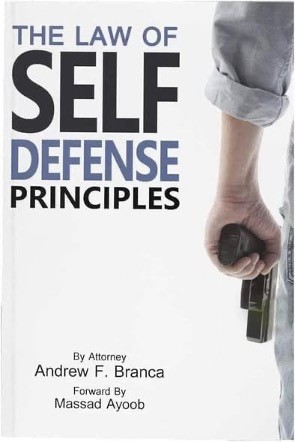
Law of Self Defense Principles (Andrew F. Branca) Attorney at Law, internationally recognized self-defense, and use of force expert.
ABOUT THE AUTHOR:
Terry L. Pittman is a North Carolina resident and concealed handgun permit holder since 2013, who is passionate about helping others understand the legal boundaries of self-defense and the importance of being prepared with both education and post-incident liability coverage. A graduate of the Charlotte Police Academy (1982), Terry served with the Charlotte Park Police from 1981–1984 and later volunteered with the Cornelius, NC Police Department from 2017–2025. He also remains active as a civilian participant in the Charlotte-Mecklenburg Police Department Ride-Along Program, where he has been involved since 2016.
Through his writing and social media presence, Terry focuses on lawful self-defense topics and encourages responsible, informed decision-making for individuals and families. While he is not an attorney and does not provide legal advice, he urges anyone with legal questions or involvement in a use-of-force incident to consult a qualified attorney in their jurisdiction. Terry is also a registered affiliate with Law of Self Defense and CCW Safe, organizations he and his wife Wendy consider key components of their personal self-defense plan.
Share this post: