
Author: Terry Pittman

The Law of Self Defense: Element 3 – Proportionality
In my previous article titled “The Law of Self Defense: Element 2 – Imminence” I focused on when you can use defensive force in self-defense.
In this article, I would like to discuss the third element of “The Law of Self-Defense”: Proportionality.
Proportionality– What is it?
Proportionality
The element of Proportionality means that the amount of defensive force you use against your attacker must not be greater than the amount of force used against you.
When talking about the element of Proportionality, I am referencing your use of force in a self-defense incident.
There are basically two types of defensive force: Non-Deadly Force and Deadly Force
- Non-Deadly Force: Often referred to as less-than lethal force, non-deadly force is force that is not expected to cause death or serious bodily injury.
- Deadly Force: Often referred to as lethal force, deadly force is force that is expected to cause death or serious bodily injury. Serious bodily injury can include permanent disfigurement or long-term damage to a part of the body. Examples include (but not limited to) broken bones, loss of a limb, severe burns, spinal cord injuries, and traumatic brain injuries, etc.).
Using deadly force in response to a non-deadly force threat will cause you to lose the element of Proportionality in self-defense. If someone punches or slaps you and you respond by stabbing them with a knife or shooting them with a gun, then such force in both situations would be deemed disproportionate and unlawful.
OTHER CONSIDERATIONS IN THE USE OF DEFENSIVE FORCE:
Duration of Force: Whether your use of defensive force is deadly or non-deadly in nature, you can only use enough force to stop the threat. Once the threat is stopped and the attacker has been immobilized, you must cease your use of further force. This relates to the element of Imminence that was discussed in the previous article.
EXAMPLE 1: Non-Deadly Force
If an unarmed assailant physically attacks you and you pull out your pepper spray or pepper gel and deliver two blasts into their eyes, you can’t go up to the assailant once they hit the ground, blinded by the chemical irritant, and begin stomping and kicking him/her. The assailant is no longer an imminent non-deadly force threat. The threat has stopped once the assailant hit the ground. Remember what I said in the previous article on Imminence. The threat must be “in progress or immediately about to happen.” Since the threat has stopped and the assailant has been immobilized, the “window” to use non-deadly force in this case has closed.
EXAMPLE 2: Deadly Force:
If you shoot an attacker in defensive deadly force and the threat has stopped you cannot continue shooting the attacker as in a “mag dump” of your pistol. Any shots made after the threat has stopped and the attacker has been immobilized would be considered unnecessary and unlawful. Such force would be deemed excessive and you would lose the element of Proportionality. In addition, you could be criminally charged and face prosecution.
REMEMBER: You don’t shoot to kill. You shoot to stop the threat.
WHY THE NEED FOR LESS-LETHAL OPTIONS FOR SELF DEFENSE?
There is a common misconception. Many people think that a firearm is the answer for every self-defense or use of force encounter. Nothing could be further from the truth. If you subscribe to that mentality and think a firearm is the ONLY weapon you need for self-defense you are sadly mistaken. You open yourself up to serious legal consequences should you find yourself in a non-deadly force encounter, need to defend yourself, and your only available option is a firearm in response to that non-deadly force threat.
A license to carry a firearm is NOT a license to kill. A firearm is NOT a universal weapon for self-defense. Not all self-defense situations rise to the level of the legal justification of deadly force.
According to the FBI and Department of Justice, you are five times more likely to be involved in a non-deadly force encounter than a deadly force encounter.
All the more reason to have some type or less-lethal weapon readily available should you have to use defensive force in self-defense involving a non-deadly force threat.
As you consider less-lethal options for self-defense, I encourage you to have a diversified self-defense toolbox. You want to have options and choose those that are most comfortable for you. The most common are pepper spray and pepper gel. They are easy to use and can readily be carried upon your person for quick access if needed to stop an imminent physical threat.
Other less-lethal options include the following:
- Stun guns
- Tasers
- Expandable batons
- Chemical and kinetic CO2 launchers (ie: Byrna, Salt Supply, etc.)
- Tactical pens
Weapons such as these, while generally considered less-lethal in nature, can still be used to inflict death or serious bodily injury, if used in an inappropriate manner. If you use a CO2 launcher and shoot someone in the eye, for example, and that person loses an eye you may face criminal charges for the use of deadly force involving a non-deadly force threat. That is because the definition of deadly force includes “serious bodily injury” also.
Furthermore, I want to say that I legally own and carry a firearm every day for self-defense. I strongly support the Second Amendment. With that said, I realize the necessity for also having other less-lethal options readily available for self-defense. If you carry a firearm in public for self-defense make sure you ALWAYS have less-lethal options readily available in the event you are faced with a non-deadly force encounter. I carry pepper spray and pepper gel with me at all times while carrying concealed in public.
REMEMBER: A firearm is NOT universal weapon for self-defense. You are also five times more likely to be involved in a non-deadly use of force threat than a deadly use of force threat.
CONTINUUM Use OF FORCE FOR CIVILIANS
Understanding the concept of the "force continuum" can empower citizens to make better informed and lawful decisions during self-defense situations.
The level of force used should be proportional to the perceived threat you are defending against. Escalating or using excessive force beyond what is necessary to immobilize the attacker and neutralize the threat can lead to legal consequences such as being criminally charged, prosecuted, and imprisonment if convicted – even for civilians acting in self-defense.
Listed below is a diagram to illustrate the Continuum of Force for Civilians:
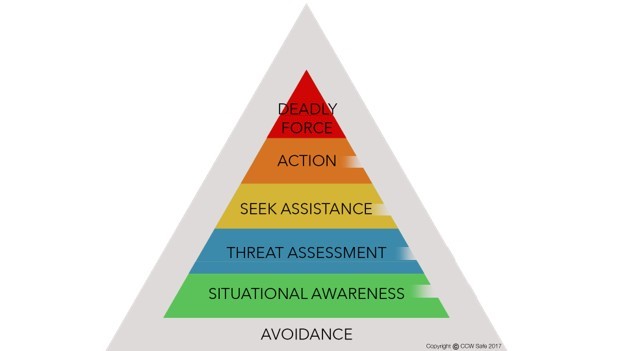
Source: CCW Safe
I would like to briefly define and discuss each of the five levels within this continuum of force model.
AVOIDANCE: The best fight is the one that you never find yourself in. When it comes to personal safety and self-defense, it is always prudent and reasonable to try and avoid putting yourself into situations that carry a higher risk of death or serious bodily injury. Even if you reside in a “Stand Your Ground” state where there is no generalized “duty to retreat” it is always in your best interest, both physically and legally, to mitigate the risk by seeking to avoid a confrontation. Think of it like electricity – you want to take the path of least resistance. Strive to find an escape if you can reasonably do so without increasing your jeopardy or safety. Avoidance should be considered as a primary “best practice” in the civilian use of force continuum.
LEVEL 1 - SITUTATIONAL AWARENESS: Situational awareness is the first level in the civilian use of force continuum. It is your most powerful tool and an essential part of self-defense. It is considered your foundation in self-defense. Situational awareness serves as the building block in developing your self-defense knowledge and the skills necessary to protect you and your family from criminal predation.
Situational awareness is the ability to perceive, understand, and effectively respond to one's situation. It involves comprehending a given circumstance, gathering relevant information, analyzing it, and making informed decisions to successfully address any potential risks, hazards, or events that might occur.
Situational awareness is a mental process that involves:
Observation: Using your senses to monitor the people and actions around you.
Orientation: Thinking about what's around you and how you're processing information.
Decision: Weighing your options and looking for the best possible outcome.
Action: Using the previous information to protect yourself and get to safety.
These actions are commonly referred as the OODA Loop.
LEVEL 2 – THREAT ASSESSMENT: Threat assessment is the second level in the civilian use of force continuum. Situational awareness and threat assessment go hand in hand. Here you are looking for things that appear outside the norm. Learn to trust your intuition and consistently strive to develop good situational awareness skills.
One of the ways you can best discern if a potential threat is legitimate is through Jeff Cooper’s Color Codes. In the book, “Principles of Personal Defense,” Cooper broke down situational awareness into four distinct levels of escalating levels:
- Code White: Unaware, Unprepared, “Tuned Out”
- Code Yellow: Relaxed, Prepared, Aware. Good Situational Awareness
- Code Orange: Identified potential threat. Ready to act.
- Code Red: High alert. Action required. Actively engaged in emergency response.
Some police and self-defense instructors have added a fifth color code – Black - which was not part of Jeff Cooper’s original book.
- Code Black: Complete panic and mental shutdown. Inability to react effectively. Freeze or become paralyzed by stress.
Ideally you want to be in Code Yellow. You are not living in a constant state of fear or paranoia, however, you are continuously scanning for potential threats as you go about your daily activities. You remain relaxed but focused on what is going on around you without being distracted. As you continue to develop your situational awareness skills, you will be able to do this rather seamlessly.
You should never be in Code White unless you are sleeping.
Threat assessment also involves determining what type of threat you are facing – Deadly or non-deadly. The type of threat you are actually facing will dictate the amount of defensive force you may lawfully use in response to that threat.
REMEMBER: Your use of defensive force must be proportional. The amount of defensive force you may legally use cannot be greater than the amount of force you are defending against.
Deadly Force: You can use deadly force to defend against a threat of death or serious bodily injury.
Non-deadly: You cannot use deadly force to defend against a non-deadly force threat (one that does not result in death serious bodily injury).
LEVEL 3 – SEEK ASSISTANCE: Seek assistance is the third level in the civilian use of force continuum.
If you are involved in a use of force incident, it is critical that you be the first person to call 911 - no matter how small or inconsequential you may think the matter was.
The first person to call 911 is seen as the “victim” in a use of force incident. If the “bad guy” calls 911 first and reports that you attacked him and you do nothing, police will be looking for YOU and YOU will be considered as the “suspect”. You have then increased your chances of being arrested and criminally prosecuted.
The first person to call 911 after a use of force event controls the narrative. If you are the “victim” you need to act and respond like the “victim.”
Example: You draw your firearm, pepper spray, or other weapon in self-defense to what you perceived was an imminent physical threat. The person who is threatening you stops their conduct and leaves the scene. You think nothing about it and go about your normal business. Unknown to you, the “bad guy” goes and calls the police telling them that you threatened them with a weapon. The police respond and now you are viewed by police as the “suspect.”
911 calls are on a recorded line. The moment the phone starts ringing recording is already in progress before the 911 dispatcher answers the call. Do not make any incriminating statements (talking to yourself about what happened or to others standing nearby). 911 calls are among the first pieces of evidence to be subpoenaed in a self-defense criminal trial. Such incriminating statements can have an adverse effect on your claim of lawful self-defense.
LEVEL 4 – ACTION: Action is the fourth level in the civilian use of force continuum.
I mentioned earlier under Avoidance that the best fight is the one you never find yourself in. If you do find yourself facing a non-deadly force threat and you are unable to escape without increasing your jeopardy or safety, de-escalation is a good option. I briefly talked about the importance of de-escalation in self-defense in my previous article The Law of Self Defense: Element 2 – Imminence,
The goal is to avoid confrontation through the process of de-escalation and verbalization.
De-escalation: When emotions are running high in a confrontation, things can take a wrong turn very quickly. You want to be able to take reasonable steps to “bring the temperature down.” Physically removing yourself from the scene without increasing your jeopardy or safety is always a good option. If you are unable to do so and depending where you are, use physical barriers to create distance between you and an attacker. Generally speaking, there is safety in distance when you are dealing with a non-deadly force threat vs. a deadly force threat (you can’t outrun a bullet).
Verbalization: Communication is a vital part of the Action step. Be aware of your tone and the words you use when facing a volatile person. Talk calmly while showing patience and understanding.
Not all situations can be addressed through de-escalation and verbalization. If you are facing an imminent deadly force threat, for example, you will most certainly not be able to attempt de-escalation. You will be compelled to immediately respond to the threat that is already in progress or immediately about to happen. You will need to take immediate physical action to immobilize the attacker and neutralize the threat.
Whatever level of force you decide to use in self-defense (non-deadly or deadly) it must be reasonable. Reasonableness is one of the required elements from the Law of Self Defense that I will discuss further in the fifth article of this series.
LEVEL 5 – DEADLY FORCE: Deadly force is the fifth level in the civilian use of force continuum.
The use of deadly force should ALWAYS be your last resort.
I cannot stress enough the importance of having a thorough understanding on each of the five elements of the Law of Self Defense. You must have all five of these elements in your favor (unless one or more are legally waived) in order to have a lawful self-defense claim. Lose any one of these elements and your self-defense claim collapses in its entirety.
The moment you pull the trigger in “self-defense” your life will change forever – legally, financially, emotionally, and psychologically. You may survive the physical fight, however, there is the legal fight to consider. Even if you though you did everything right, you may still be arrested, criminally prosecuted, and possibly face decades or perhaps life imprisonment if convicted.
The costs of defending yourself in a criminal trial are astronomical. You can reasonably expect to accumulate $150,000 to $200,000 in attorney fees and legal expenses in pre-trial costs alone.
Depending upon the complexities of your case, these costs could escalate to approximately $400,000 or more just to defend yourself against criminal liability.
Then there is also the civil trial to consider. The victim or the victim’s family sues you in court for monetary damages associated with the shooting.
Know the legal boundaries of self-defense. Protect yourself from criminal and civil liability.
QUESTION: Am I required to progress through each of the five levels systematically before I can use deadly defensive force?
ANSWER: No.
While the use of deadly force should be a last resort option, circumstances can occur where you would not be required to systematically go through each level before using deadly defensive force.
EXAMPLE:
A situation can start out as non-deadly. Perhaps you and another person are having some type of verbal confrontation. Before you can attempt to remove yourself from the confrontation (Avoidance) or possibly attempt to de-escalate the situation (Level 4: Action), the other person suddenly exhibits a firearm and attempts to shoot or points it at you. At this point, you are now facing an imminent deadly force threat. The other person just escalated what was a non-deadly force threat into deadly force threat. You would immediately escalate your response to Level 5: Deadly Force in response to that deadly force threat. After being compelled to use deadly force, then you would go to Level 3: Seek Assistance and call 911 to request police and medical response to your location.
KEY TAKE-AWAYS ON PROPORTIONALITY IN SELF-DEFENSE:
- Your use of force must be proportional. It cannot be greater that the amount of force you are defending against.
- Develop your situational awareness and threat assessments skills to help you make informed decisions in self-defense.
- Be the first to call 911 if involved in any use force event.
- A firearm is not a universal weapon for all use of force event.
- Have a diversified self-defense toolbox that includes less-lethal options.
- You don’t shoot to kill. You shoot to stop the threat.
- The best fight is the one that you are never in (Avoidance)
- Not all situations can be de-escalated.
- The use of deadly force should always be your last resort.
Source content for this article is derived largely in part from the following:
Law of Self Defense Principles (Andrew F. Branca) Attorney at Law, internationally recognized self-defense, and use of force expert.
CCW Safe – a leading provider of comprehensive self-defense coverage against criminal and civil liability.
In the next article of this series, I will discuss the fourth element of the Law of Self Defense – Avoidance.
In this element, I will cover Stand Your Ground vs. Duty to Retreat as well as the Castle Doctrine.
I hope you will join me as we move through each of the five elements of the Law of Self Defense.
ABOUT THE AUTHOR:
Terry L. Pittman is a North Carolina resident and concealed handgun permit holder since 2013, who is passionate about helping others understand the legal boundaries of self-defense and the importance of being prepared with both education and post-incident liability coverage. A graduate of the Charlotte Police Academy (1982), Terry served with the Charlotte Park Police from 1981–1984 and later volunteered with the Cornelius, NC Police Department from 2017–2025. He also remains active as a civilian participant in the Charlotte-Mecklenburg Police Department Ride-Along Program, where he has been involved since 2016.
Through his writing and social media presence, Terry focuses on lawful self-defense topics and encourages responsible, informed decision-making for individuals and families. While he is not an attorney and does not provide legal advice, he urges anyone with legal questions or involvement in a use-of-force incident to consult a qualified attorney in their jurisdiction. Terry is also a registered affiliate with Law of Self Defense and CCW Safe, organizations he and his wife Wendy consider key components of their personal self-defense plan.
Share this post: