
Author: Alan B. Densky

Open carry may be legal in many places, but legal does not always mean smart in every situation. A visible handgun changes the way strangers see you. It may change the way a business owner treats you. It may also change the way a criminal evaluates you.
That is why open carry training must be direct. The question is not only, “Am I allowed to carry openly?” The better question is, “What problems do I create when I advertise that I am armed?”
You Give Up the Element of Surprise
A concealed firearm is private information. An openly carried firearm is public information.
If a violent criminal sees your gun, he knows where it is, which side you carry on, and what he must deal with first. That may not scare him away. It may simply cause him to change his plan.
Some people argue that open carry deters crime. Sometimes it might. But deterrence is not guaranteed. A determined attacker may decide to surprise you first, distract you, come up from behind, or target the gun before you have time to react.
When you carry concealed, the attacker may not know you are armed until you choose to act. When you carry openly, he knows before the fight starts.
You May Put a Target on Your Back
Open carry can make you stand out. In some places, you may become the most noticeable person in the room.
A visible firearm may attract nervous customers, curious strangers, store employees, managers, law enforcement, or criminals. Some people may stare. Others may challenge you. A few may try to provoke you.
That is a bad place for an armed citizen to be. If you are carrying a firearm, you should be trying to avoid unnecessary attention, not invite it.
Responsible carry is not about proving a point. It is about protecting life.
Gun Grabs Are Real
One of the biggest problems with open carry is simple: the gun is visible, reachable, and tempting to the wrong person.
Even trained police officers have had guns grabbed, pulled, or fired during struggles. Officers use duty holsters, receive training, and still face gun-grab attempts. If that can happen to a trained officer, a civilian with a visible handgun and little retention training should take the risk seriously.
A criminal does not need to win a gunfight if he can take your gun before the fight begins. He only needs a moment of surprise, a poor holster, a crowded space, or access to your gun side.
This is one reason defensive pistol training should include awareness, distance, retention concepts, and decision-making instead of only slow-fire marksmanship.
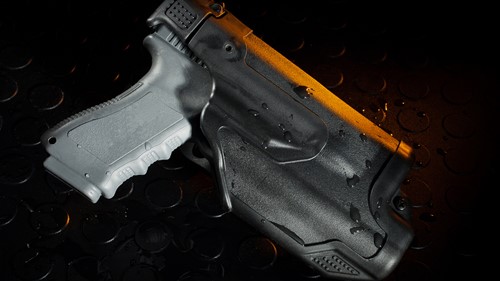
Open carry without retention training is a dangerous fantasy. A basic open-top holster may hold a pistol while you walk around. That does not mean it will protect the gun from a grab.
Retention Is Not Just Equipment
A retention holster is important, but it is not magic. Equipment can help. It cannot replace awareness.
Open carry training should include how to protect the gun side of the body, keep distance, avoid letting strangers crowd you, and recognize when someone is closing space for the wrong reason.
If you are standing in line, do you know who is behind you? If you are pumping gas, is your gun side exposed? If you are in a store aisle, can someone come up behind you? These are not range questions. These are public-carry questions.
The person who carries openly must think about access to the gun from every direction, especially from the rear and the gun side.
Store Policies Still Matter
Open carry can create conflict with private businesses. A store may allow lawful concealed carry but discourage or prohibit open carry. A manager may ask you to leave. An employee may not know the law. Another customer may complain.
The right answer is not to argue at the counter.
If a business asks you to leave, leave calmly. Do not debate. Do not lecture. Do not turn a policy disagreement into a public scene while armed.
The goal of carrying a firearm is safety. It is not to create unnecessary conflict.
Concealed Carry Often Makes More Sense
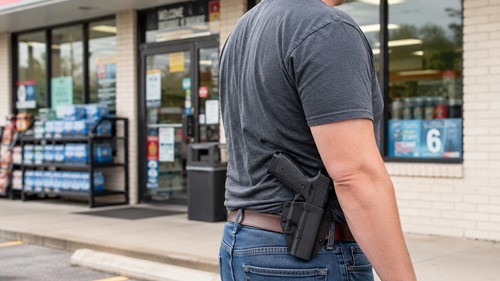
Open carry may be legal. It may even be appropriate in some settings. But for many ordinary public situations, concealed carry is often the more practical choice.
Concealed carry helps you avoid unnecessary attention. It protects the fact that you are armed. It reduces the chance that someone will target the gun itself. It also lets you move through public places without turning your firearm into the first thing people notice.
For many students, the smarter path is not simply choosing open carry or concealed carry. The smarter path is getting proper Florida concealed carry training before carrying in public.
Concealed carry does not solve everything. You still need safe handling, a good holster, lawful judgment, and training. But privacy can be valuable.
Open Carry Training Should Be Honest
Open carry training should not pretend that a visible gun automatically makes you safer. It may deter some people. It may alarm others. It may attract attention. It may create arguments. It may give up surprise. It may also give a criminal a clear target.
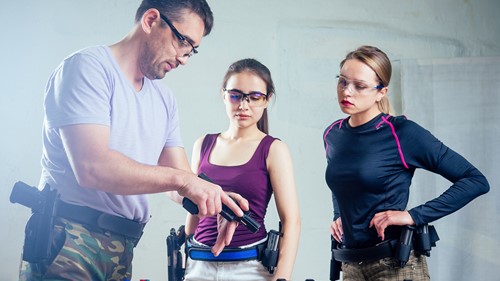
Before you carry openly in public, get training. Learn the law. Understand private-property issues. Use a secure holster. Practice awareness. Learn when to leave. Learn when not to argue. Learn that the gun is not a badge, a warning sign, or a conversation starter.
A firearm is a last-resort defensive tool. Carry it with humility, discipline, and good judgment.
Students who want practical firearm training in North Central Florida should look for instruction that covers safety, judgment, lawful carry, and real-world responsibility.
Share this post: